

Through a Netherlands authorities television initiative titled "Turn the Switch" an actress alerts audience members about their power consumption.
"Whenever we all use power at the identical moment, our power grid gets overloaded," she states. "This can cause failures. So, use as little energy as possible between four and nine."
It is a indication that, in one of the highly developed economies in the globe, something has developed problems with the nation's electricity provision.
EV Adoption and Renewable Energy Growth
Holland has been an enthusiastic user of EVs. It has the greatest quantity of charging points per capita in the European continent.
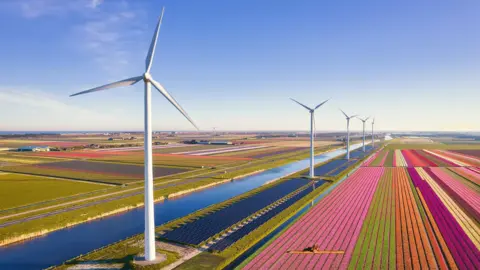
Regarding power generation, the Netherlands has substituted gas from its substantial North Sea resources with wind and solar.
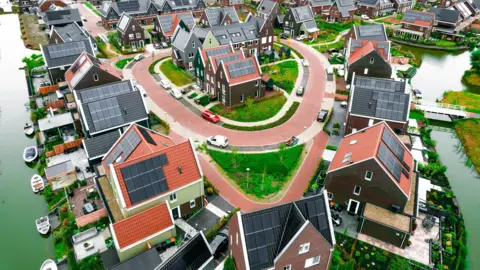
So much so that it leads the path in the region for the number of photovoltaic panels per person. Actually, over one third of Dutch households have solar panels installed.
The country is also aiming for sea-based wind energy parks to be its biggest source of power by 2030.
Network Overload Challenges
While this is all positive in environmental aspects, it's putting the Netherlands' power network under significant stress, and in recent years there have been a series of outages.
This issue is "grid congestion", explains an energy executive, CEO of a Dutch energy producer and provider.
"Grid congestion is similar to a traffic jam on the power grid. It's triggered by either excessive energy consumption in a certain region, or too much energy generation fed into the grid, beyond what the system can manage."
He explains that the challenge is that the grid "was designed in the era when we had only a few of very large, primarily gas-powered power plants".
"Therefore we built a network with large power lines close to those power plants, and increasingly smaller power lines as you got more towards the households.
"Currently we're transitioning to renewables, and that implies there's a significant energy being injected into the network in the outskirts of the system where there are just comparatively small power lines."
And these small power lines are finding it difficult to cope with all the electricity coming in from wind turbines and PV systems scattered around the nation.
Specialist Analysis and European Situation
An electrical engineering professor, professor of power systems at a European institution, is one of Europe's leading experts on power networks. He says it is an costly issue for the country to resolve.
"The Netherlands have a grid crisis because they haven't invested enough in their local grids, in their transmission networks, so they are facing constraints throughout, and it will take years and billions of dollars to address this."
Prof Ernst adds that it is a Europe-wide problem. "European nations have an enormous amount of solar panels being deployed, and they are installed at a rate that is much, much excessive for the grid to be able to handle."
Management Approaches and Consumer Effects
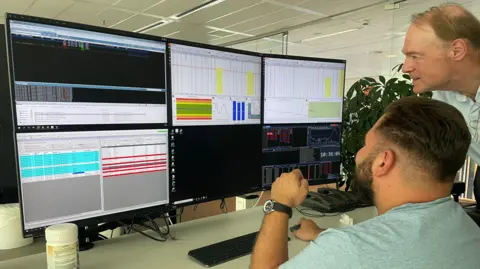
At a leading energy company's main office in Rotterdam, company leaders showcase a large monitoring system that the organization calls its "virtual power plant" and "the control center of our operations". It is used to assist in stabilize the grid, avoiding power failures.
When electricity generation is too high throughout the country, it allows operators to turn wind turbines away from the wind and turn off PV systems.
Regarding situations where demand for power is peak, it reduces the energy to customers who have agreed to permit energy companies to stop or reduce their power delivery when the network is under pressure in return for reduced rates.
But for households and businesses who want to scale-up their consumption of electricity with a additional or bigger grid connection, that, increasingly, is just not feasible.
"Frequently customers desire to set up a heat pump, or power up their EV at their residence, but that needs a significantly larger electricity link, and increasingly they simply cannot obtain it," explains the company representative.
He adds that it is worse for companies. "Typically they want to expand their activities, and they simply cannot get additional capacity from the grid operators.
And it has reached the point where even new housing construction in the country is becoming progressively challenging, because there's simply no capacity to link those developments to the grid."
Those individuals, and businesses, end up on waiting lists for a several of years. At the same time there are additionally backlogs for those who want to feed the grid with energy, such as a recently built house equipped with PV systems on its top.
Economic Impact and Future Strategies
State-operated agency that runs the Netherlands' power network says that 8,000 companies are presently waiting to be able to feed in power, while 12,000 others are waiting for authorization to consume additional energy.
Certain sectors of the Netherlands economic system are warning that it is hindering their expansion. "Network overload is putting the future of the Dutch chemical sector at risk… while in other countries it will be easier to put money," states the Head of a leading industry association.
Therefore, was this situation avoidable? "Looking back I believe almost every problem is avoidable," says the industry leader.
He adds that following the 2015 climate accord on aiming to address global warming, "the industry were very much focussing on expanding the renewable power generation aspect. But we somewhat underestimated the impact it would have on the power grid."
Network managers is now preparing to spend €200bn on strengthening the network, comprising installing some 100,000 kilometers of additional power lines between the present and 2050.
That's a massive sum of money, but there is additionally a big economic impact to not spending it. Grid congestion is costing the Netherlands economic system up to €35bn a annually, according to a recent report from a business consulting group.
An experienced official responsible for network issues says that patience is sadly necessary. "In order to strengthen and upgrade the grid, we must increase twofold, threefold, sometimes increase tenfold the capacity of the existing system.
"Furthermore it's taking on typical about 10 years to


